The olive year is twelve months long and the harvest is three weeks short. Everything the tree did before comes down to one decision about when to pick — and to how fast you can get to the mill.
Apanha, varejo, and a word that means hitting a tree with a stick
The Portuguese for the olive harvest is a apanha, from apanhar: to catch, to pick up. The older word is varejo, from vara, a pole — you beat the branches and the fruit falls. Both words are honest about the work. Nobody in the history of olives has ever described this as gathering.
Everything the tree does across twelve months — flowering in spring, setting fruit, surviving an Alentejo August — is settled in roughly three weeks between late autumn and the turn of the year. Miss the window and you still get a year. It is just a worse one.
Oil is not made in the mill. It is decided in the tree.
Green, turning, black: the only decision that matters
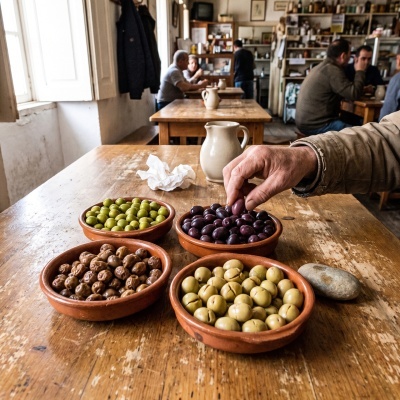
An olive changes as it ripens: green, then streaked with purple, then black. Pick early, at green or turning, and you get fewer litres per hundred kilos but far more polyphenols — the bitter, peppery compounds that give oil a taste of its own and keep it stable for longer. Pick late, when the fruit is black and soft, and you get volume, sweetness, and an oil that fades faster in the bottle.
So the harvest date is not logistics. It is a flavour decision, taken weeks in advance by somebody standing in a grove looking at fruit and at a forecast.
Nets, poles, and the rule about the ground
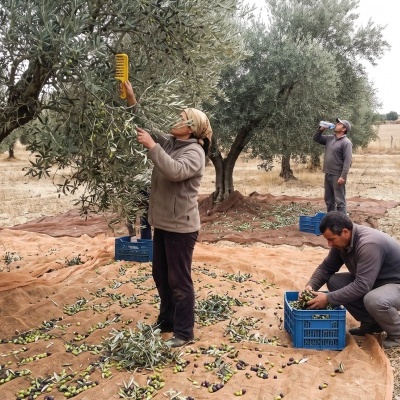
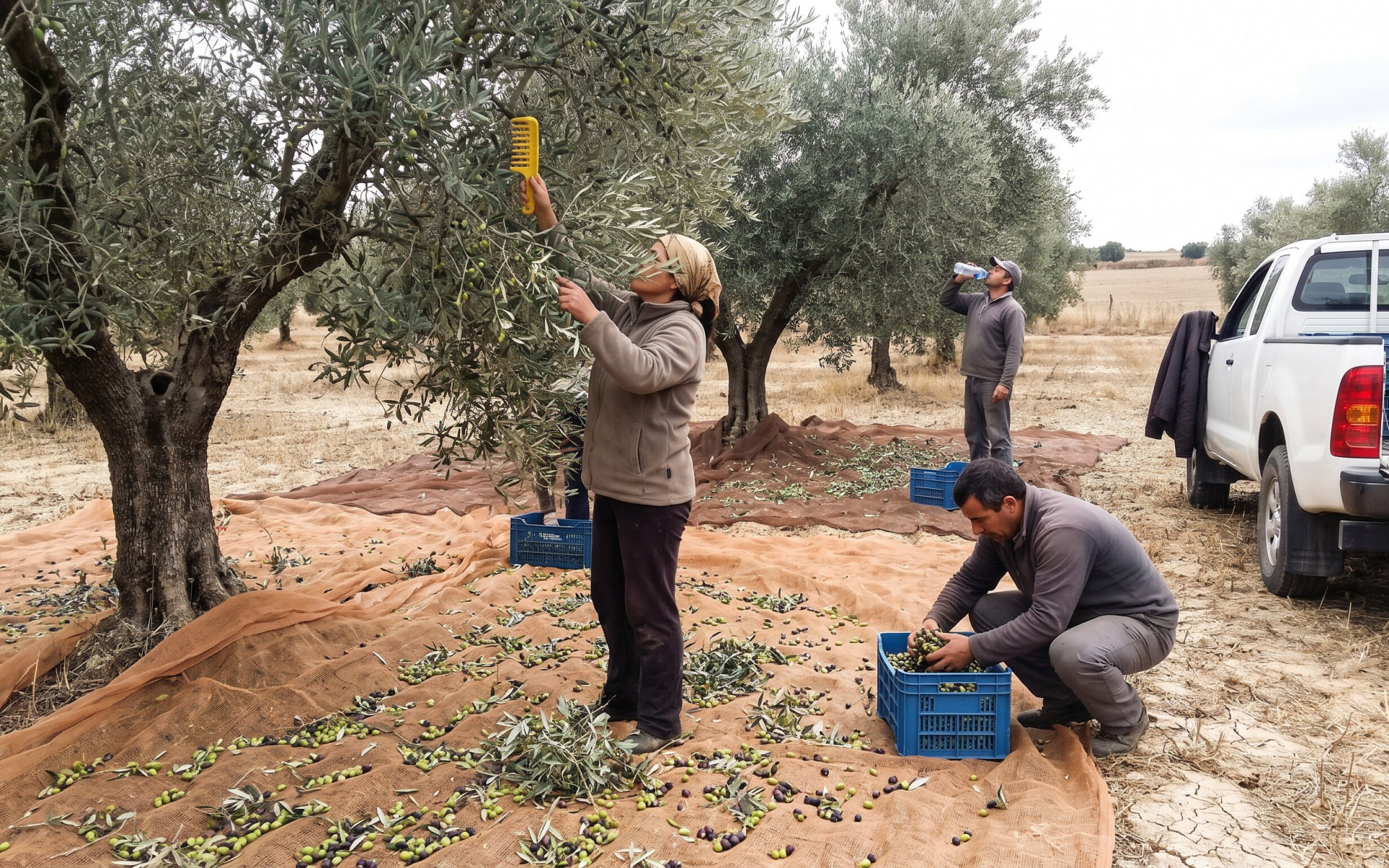
The shape of the day has not changed much. Nets go down under the tree first, overlapping, pulled tight around the trunk. Then the branches are worked — by hand and pole in old groves, by a mechanical shaker where the trees are planted in lines. The olives roll to the middle of the net, get lifted, get sorted.
And the rule everybody repeats: fruit that has fallen and sat on the ground never goes in with the rest. It bruises, it picks up soil and yeasts, it starts to turn. In a good grove it is kept apart or left where it lies. That single act of discipline is the difference between an oil with defects and an oil without.
The clock starts the moment the olive leaves the tree
A picked olive is a picked fruit, and a picked fruit starts breaking down. The rule in any serious mill is that the day's harvest is milled the same day, or at the very worst the next. Leave the fruit piled in sacks for three days in a warm shed and it ferments, and that ferment stays in the glass for the life of the bottle.
Cold extraction — the phrase on the label — is not poetry either. It means the paste is never worked above 27 °C. More heat would release more oil. It would also cook off exactly the aromatics you spent a year growing.
Azeite novo: the oil that bites
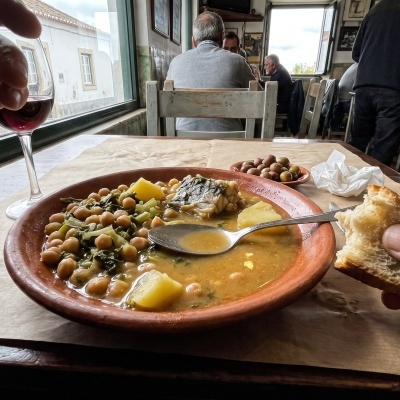
The first oil of the season goes into bottles cloudy, thick and startlingly green, and it bites. There is a peppery catch at the back of the throat that makes first-time tasters cough, and people who have been told that good oil is smooth often assume something has gone wrong.
Nothing has gone wrong. The sting is a marker of the same polyphenols that make the oil last. Bitterness and pepper are not faults to be filtered out of Portuguese olive oil; they are the receipt.
Who is actually in the grove
The harvest is the most social month of the agricultural year. Groves that are silent for eleven months fill up with families, neighbours, ladders and dogs. Lunch is cooked in the grove, on a fire, by whoever is best at it, and the afternoon is slower than the morning because of it.
We have a property in Alentejo where we do this ourselves — the picking, the mill, the oil — and we open it to guests during the harvest, in late October and early November. You pick, you go to the mill with what you picked, and you taste the oil in the same week it was still fruit.
What a harvest day needs
Nets. A pole. Crates that stack. Cold hands. And somebody who cooks at noon.
THE YEAR BEFORE THE HARVEST
A gastronomic guide to Alentejo follows the olive from flower to bottle, and maps the mills, tables and villages that live off it.
EXPERIENCE IT IN PERSON
Pick with us in the grove this season. Discover our Alentejo experiences →