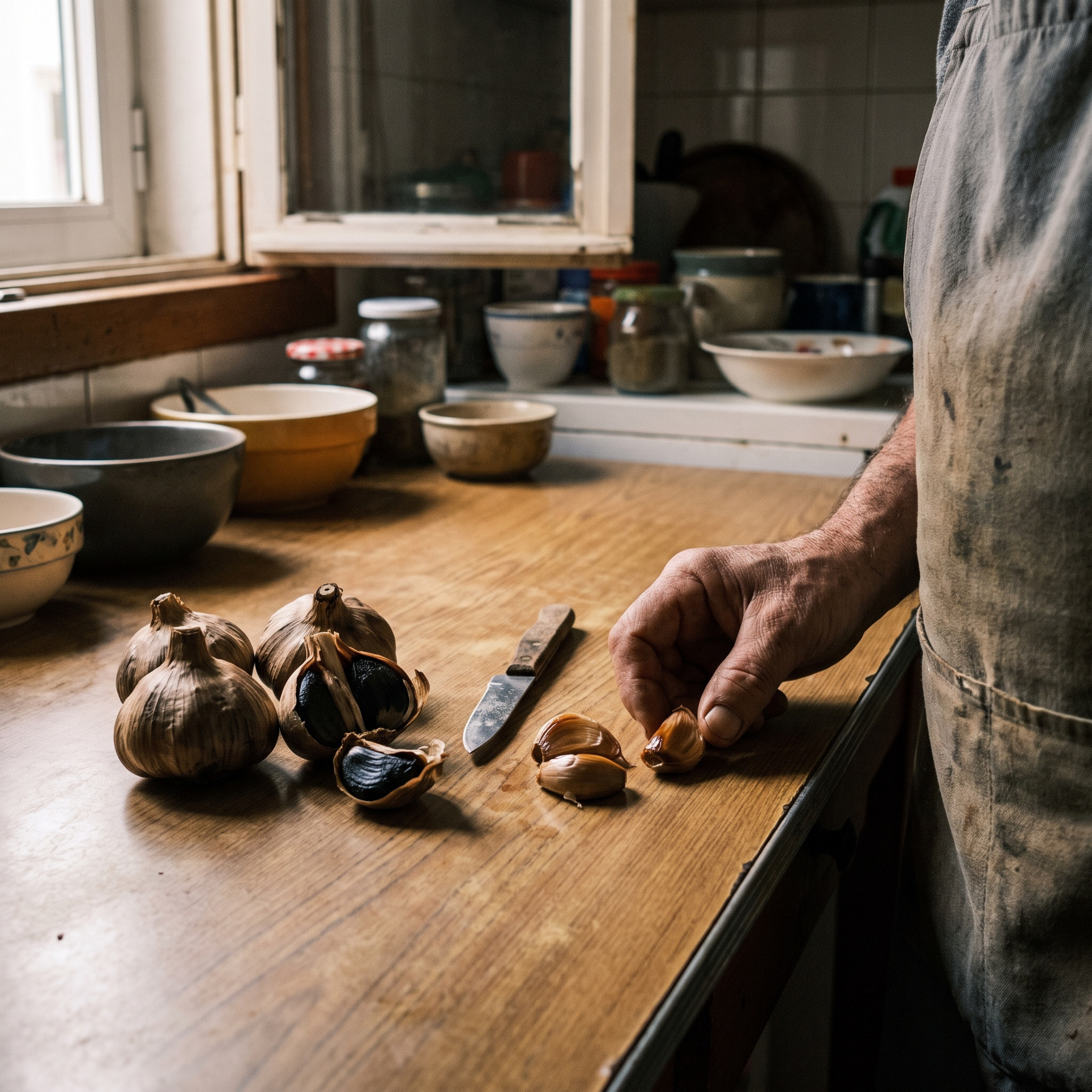
Everyone calls it fermented. It is not. Black garlic is what happens when an ordinary bulb is kept warm and humid for weeks, until its sugars and proteins rearrange themselves into something closer to tamarind.
The name is wrong and the wrong name stuck
Black garlic is sold, almost everywhere, as fermented garlic. It is not fermented. Fermentation means microorganisms are doing the work — yeasts, bacteria, something alive converting sugars. In a chamber of black garlic, nothing is alive and nothing is converting anything on your behalf.
What is happening is slower and stranger: the bulb is cooking itself, at a temperature low enough that it never behaves like cooking.
What the heat actually does
Put whole heads of ordinary garlic into a chamber held at a gentle, steady warmth and a high humidity, and leave them there for weeks. Two things happen at once.
The first is the Maillard reaction — the same set of reactions between sugars and amino acids that browns bread crust and roast meat, except that here it runs for weeks instead of minutes. That is where the colour comes from, and the depth. The second is that the harsh sulphur compounds that make raw garlic aggressive break down. The heat that pushes the colour towards black is also removing the reason people are careful about garlic.
The result is a clove that is soft, dark, slightly sticky, and has stopped being a seasoning and started being an ingredient.
Time is the only ingredient
There is nothing added. No salt, no sugar, no starter culture, no smoke. Garlic goes in; time and warmth are applied; black garlic comes out. Anyone selling you a version with a list of ingredients is selling you something else.
Different makers work to different clocks — some take three weeks, some take two months, and the longer runs generally come out darker, sweeter and softer. Ours spends sixty days in the chamber, and then rests before it is packed, because a bulb straight out of the heat is still deciding what it wants to taste like.
What it tastes of
Not of garlic, which is the first surprise, and not of anything most people can name on the first attempt, which is the second.
The usual reference points are balsamic vinegar, molasses, dried fig, tamarind and a little liquorice. There is a savoury undertow that lands in the same place as soy or aged cheese. There is sweetness, but it is the sweetness of something reduced, not of something sugared. And the aftertaste is clean: black garlic does not stay on your breath, which is a fact worth knowing before you plan an evening around it.
Black garlic is to raw garlic what a dried fig is to a fresh one: same fruit, less water, more of everything else.
Eat a clove on its own and you get the whole slow room in your mouth — weeks of low heat, in one bite.
How to use it without cooking it to death
The most common mistake is treating it like garlic. It has already been cooked for weeks; putting it in a hot pan at the start of a recipe undoes the work.
Mash it into softened butter with salt and spread it on toasted bread. Whisk it into a vinaigrette with olive oil and a little vinegar, where it does the job of both sweetness and depth. Fold it through a mayonnaise or aioli. Drop whole cloves into a stew in the last five minutes. Put it on a board with sheep's cheese and let people work it out. Add it at the end, always.
Note: it does not need refrigerating in the way fresh garlic does, but it does need to stay dry and sealed. The packaging tells you exactly how, and that is the part we do not improvise.
Where it comes from and where ours is made
Black garlic is not a Portuguese tradition. The technique is East Asian and it arrived here recently, which is a reasonable description of most of what Portugal eats: the country has been importing techniques and making them local for six hundred years.
Glocal is the word for this — a global method, done with local material, for a local table. Portuguese bulbs, a chamber in Portugal, and a result that belongs to neither place entirely.
SLOW IS A METHOD, NOT A MOOD
Slow food travel in Portugal: a field guide follows processes that take weeks — curing, drying, brining, ageing — and the people who wait them out.