Portugal's national fish does not live in Portuguese water. It was caught thousands of kilometres away, buried in salt and carried home — which is precisely why it ended up belonging to us.
A national fish from somebody else's sea
The fish Portugal considers its own is Atlantic cod, and Atlantic cod does not live off Portugal. It lives in cold northern water — Newfoundland, Iceland, the Barents Sea — thousands of kilometres from any Portuguese port. Nobody here has ever pulled one out of the water at home.
Portugal nevertheless eats more of it per head than anyone, cooks it at Christmas, argues about it constantly, and calls it fiel amigo: the faithful friend. A country adopted a fish it had to sail for.
Salt was the technology
Understand the salt and the whole story falls into place. Long before refrigeration, Portugal had two things in quantity: ships, and salt pans on a coast with the right combination of sun and wind. Salt was the country's export and its preservation technology.
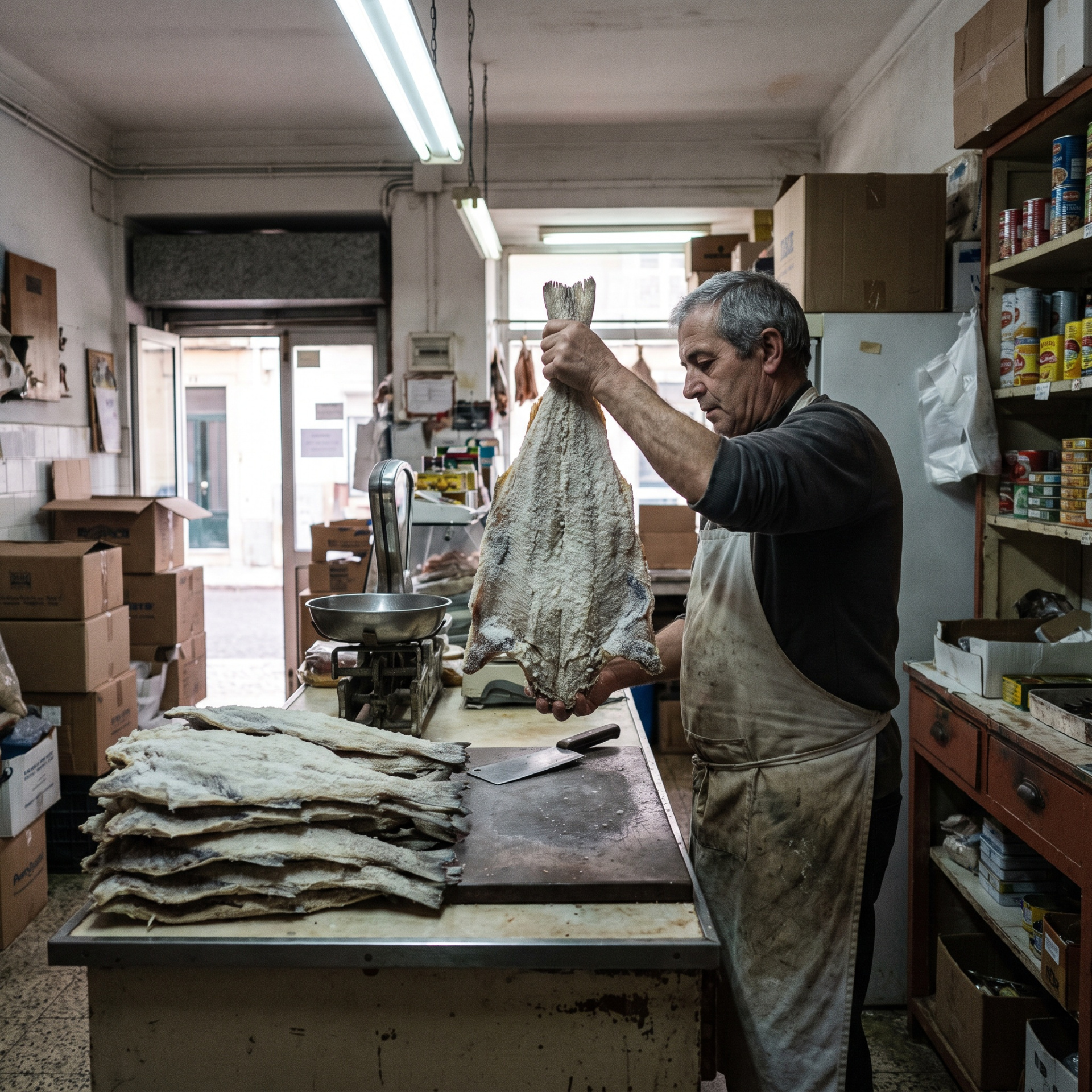
Split a cod, bury it in salt, dry it, and you have a protein that survives months at sea, months in a warehouse and a winter in a pantry with no cold anywhere in the chain. Portuguese fleets were making the northern voyages by the sixteenth century, and the arrangement was almost too neat: salt goes north, fish comes back.
The faithful friend was faithful because it kept.
The fleet the state made famous
In the twentieth century the cod fishery became state business. Under the Estado Novo, a national campaign built and blessed a fleet of sailing schooners — the white-hulled ships people still call the White Fleet — and sent them to the Grand Banks with an emphasis on national self-sufficiency and a great deal of propaganda about hardship as virtue.
The reality on board was that men rowed out alone in small flat-bottomed boats, single-handed, fished with line in fog, and came back or did not. The photographs from those campaigns are the reason bacalhau in Portugal carries a weight that no other ingredient does. It is not just food. It is a national memory with a recipe attached.
The recipes nobody has counted
You will be told there are 365 ways to cook bacalhau, one for each day of the year. Some people say a thousand.
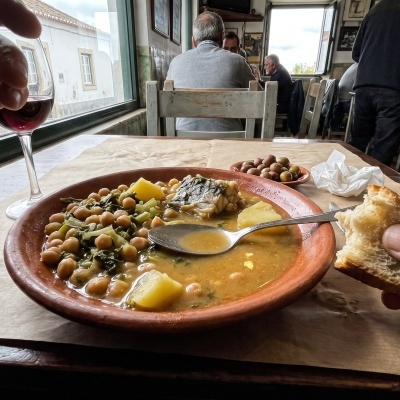
Note: nobody has ever published the list. It is a good number that became a fact by repetition, which is a very Portuguese way for a fact to happen. What is true is that the repertoire is enormous and regional, and that the famous ones — a Bras, with matchstick potatoes and egg; a Gomes de Sa, from Porto; com natas; pataniscas fried in batter; and the plain boiled one with cabbage, potato, egg and a river of olive oil that anchors Christmas Eve — are only the entrance.
How to buy it and how to bring it back
Buy it thick. A thin tail-end piece will fall apart and taste of salt and nothing else; the money goes into the loin, the cut Portuguese shops call the lombo. Look for a piece that is creamy white rather than yellowing, and firm rather than floppy.
Then desalt it, which is where most people abroad go wrong. Rinse the surface salt off, submerge the fish in cold water, and put it in the fridge — not on the counter — for a day or two depending on thickness, changing the water three or four times. Taste a flake before you cook. Under-soaked bacalhau is inedible; over-soaked bacalhau is just an expensive white fish.
And this is where our name comes from
Oh! My Cod is a substitution: God becomes Cod, and the fish takes the place of the deity, which is roughly the position it holds at a Portuguese Christmas table anyway.
The creature in our logo is the Porcalhau — porco plus bacalhau, a pig with a fish tail, and close enough to porcalhao, the Portuguese word for a messy eater, that the joke works twice. It has been with us since 2016. It exists because those two animals, the pig and the salt cod, carry more of this country's food history between them than anything else on the table.
A new species of tour needed a new species. We built one out of the two ingredients we could not choose between.
WHERE THE CITY STILL COOKS IT
A gastronomic guide to Lisbon maps the shops that still sell cod by the cut and the kitchens that treat it as more than a Christmas obligation.
EXPERIENCE IT IN PERSON
Eat the city with us. Discover our Lisbon experiences →