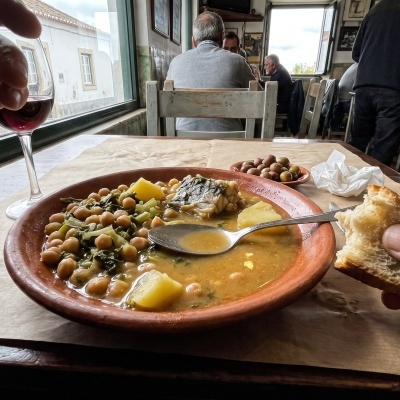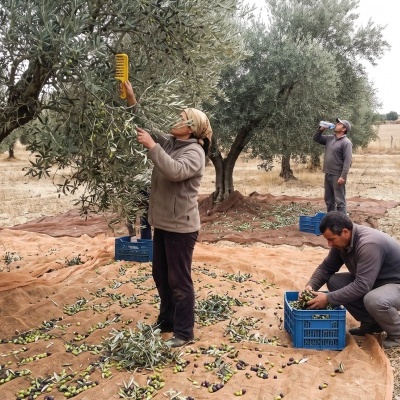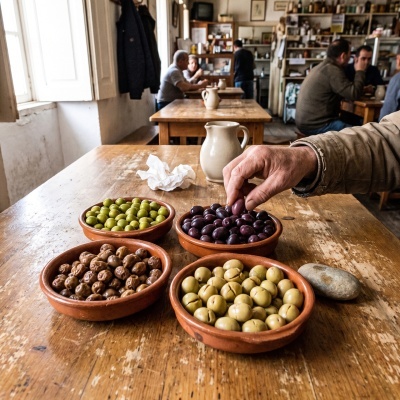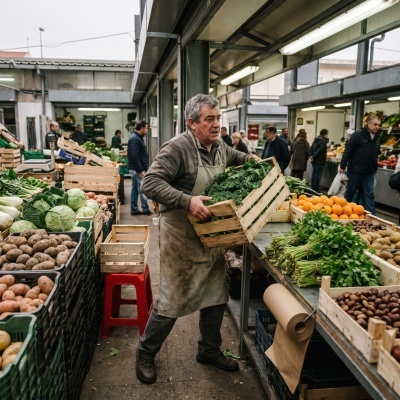
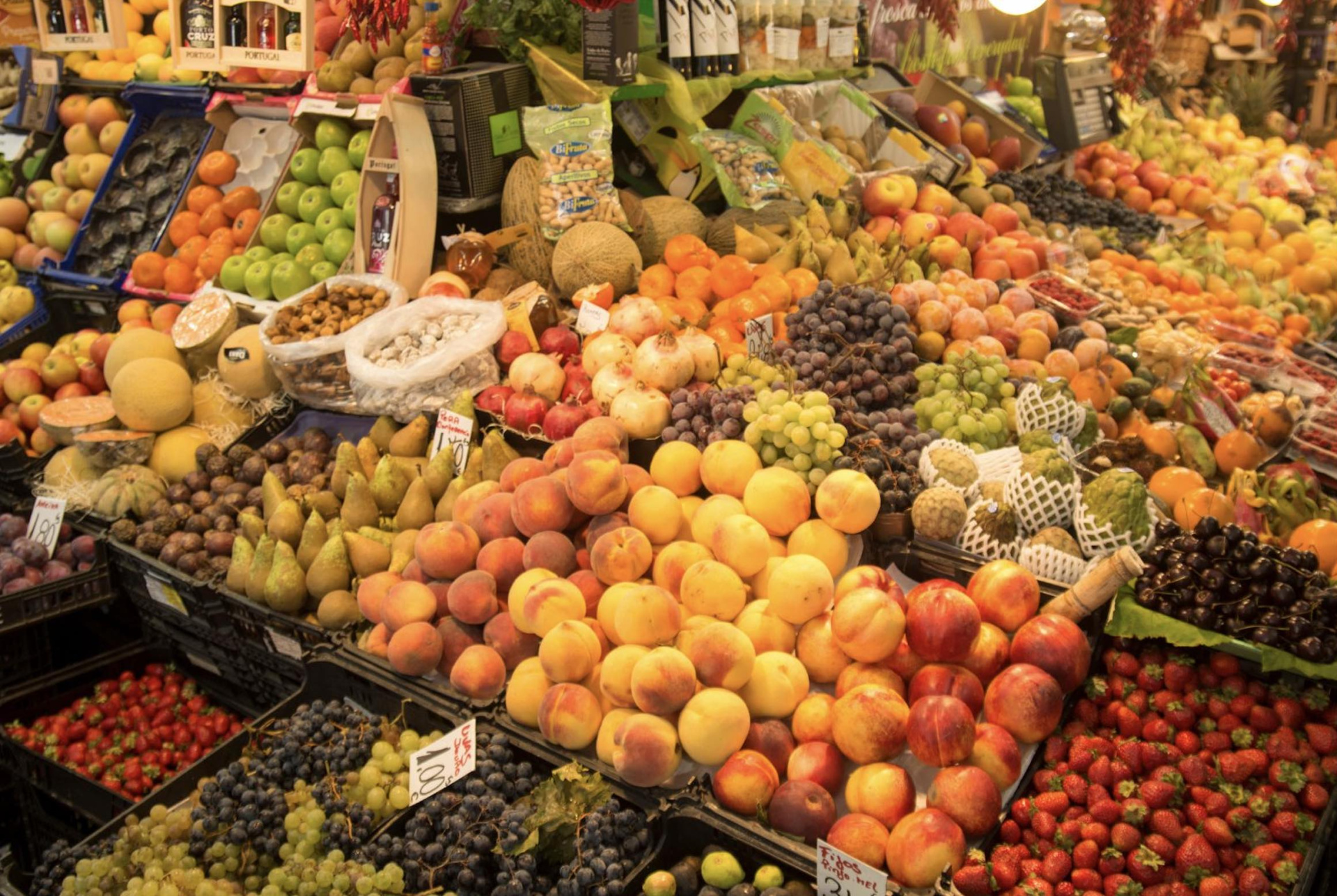
A market is a text. Once you know how it is organised — who grows, who resells, and who only appears for three weeks a year — you can read an entire region off a table of vegetables.
Mercado, praca, feira: three words, three different places
Portuguese uses three words where English mostly manages with one, and knowing which is which tells you what to expect before you arrive.
A mercado is the covered municipal market: a permanent building, fixed stalls, fishmongers on the cold side, open most mornings. A praca is what people often call the trading floor of that building, or the square it grew out of. A feira is the periodic open-air one — a Tuesday, a first Sunday, a saint's day — and the word comes from the Latin feriae, meaning holidays: the days when nobody worked, so everybody traded. Two thousand years later, the fair is still on the day the town is off.
Learn to tell a grower from a reseller
Both are legitimate. But only one of them can answer questions.
A reseller has volume, uniformity and range: forty crates, everything available in every season, fruit sized as though it went through a machine, because it did. A grower has three crops, uneven sizes, soil still on things, quantities that will run out by eleven, and very often the worst position in the market — the edge, the doorway, a folding table, sometimes a blanket on the floor.
That corner is where the good tomatoes are.
The piles tell you the season
A market is a chart of the agricultural year, drawn in volume. Whatever is stacked highest, cheapest and everywhere is what the region has just harvested, and it is always the thing to buy. Whatever sits in a small tidy pile at a startling price arrived from a long way away.
So you do not need to memorise a calendar. Walk in, look for the excess, and buy that. In September the excess is figs and grapes; in November it is chestnuts and quinces; in June it is silver and it is on ice.
The one question that works
Walk up and ask: o que e que esta bom hoje? What is good today?
It is a better question than what is fresh, because everything is claimed to be fresh, and a better question than what do you recommend, which invites a sales answer. What is good today asks the person to make a judgement about their own stall in front of you, and most Portuguese vendors will answer honestly, because their answer will be tested by whoever is standing behind you in the queue.
The follow-up is even better: e o que e que se faz com isso? And what does one do with that? You will get a recipe. Sometimes you will get three, and an argument between two stalls about which is correct.
When to arrive
Early for fish, and early means early — the counters are cleaned and closed by lunchtime in most municipal markets. Many fish stalls are thin on a Monday, because the boats do not land on a Sunday, and no amount of charm changes that.
Late is for the last hour, when growers who do not want to carry crates home start doing arithmetic out loud. Both ends of the morning are good. The middle is for tourists.
What to bring
Cash, in small notes, because a twenty-euro note for a kilo of oranges is a social event nobody enjoys. A bag that carries weight, since bags are not assumed. A phone with a translation app, used sparingly.
And time to be told a story you did not ask for, which is the actual reason to go.
Why we start every trip here
We take guests into markets before we take them anywhere near a restaurant, because the market is the only place where the whole region is on one table at the same time and someone is willing to explain it.
A menu tells you what a kitchen has decided. A market tells you what the land did this month.
THE MARKETS, WITH ADDRESSES
A gastronomic guide to Lisbon lists the city's markets by day and by speciality, with what to buy at each and who to buy it from.
EXPERIENCE IT IN PERSON
We start in the market. Discover our Lisbon experiences →